K-12 Teachers
Breaking Through: Identifying Culturally Relevant Strategies to Maximize Students’ Brilliance
Strategies For STEM Learning, Possibilities And Futures
Black boys need to be seen as capable, brilliant learners. To further nurture their brilliance, incorporate these strategies:
- Adopt an asset-based mindset where all students are viewed as capable learners of science, technology, engineering, and mathematics (STEM)
- Acknowledge and celebrate students’ unique identities and backgrounds
- Teach using culturally relevant pedagogies (real-world connections to a student’s unique identities, backgrounds, and communities)
- Provide examples of everyday STEM innovations and their innovators of color
- Build relationships and rapport with students, families, and their local communities
- Incorporate play-based learning and engagement in technology in your teaching lessons
- Partner with parents, family, and community members to learn more about your student and identify relevant issues within their local communities

Reflection Questions For Teachers
- How do my identities and background inform my assumptions about my Black male student and my approaches to teaching?
- How might my education in STEM be similar and/or different from that of my Black male student?
- How might my education in STEM be similar and/or different from how I teach my Black male student?
- How might my Black male student’s differences be assets to his learning of STEM?
- What are my current gaps in knowledge as it relates to teaching Black male students? And how (and where) might I go to seek additional knowledge and help to improve my instructional practice?
- What practical, everyday occurrences might more strongly connect class lessons to my Black male student’s learning?
- What are my Black male student’s strengths and curiosities? How can I link his strengths and curiosities to my lessons?
- How can I make minor adaptations to lesson planning to further connect to my Black male student?

Printable Handout
Each handout includes general information about Black males along various STEM pathways, tips or recommended practices, and reflection questions. The reflective questions have been provided to support ongoing conversations toward the support of Black males in STEM. The questions can be used individually or as a group.
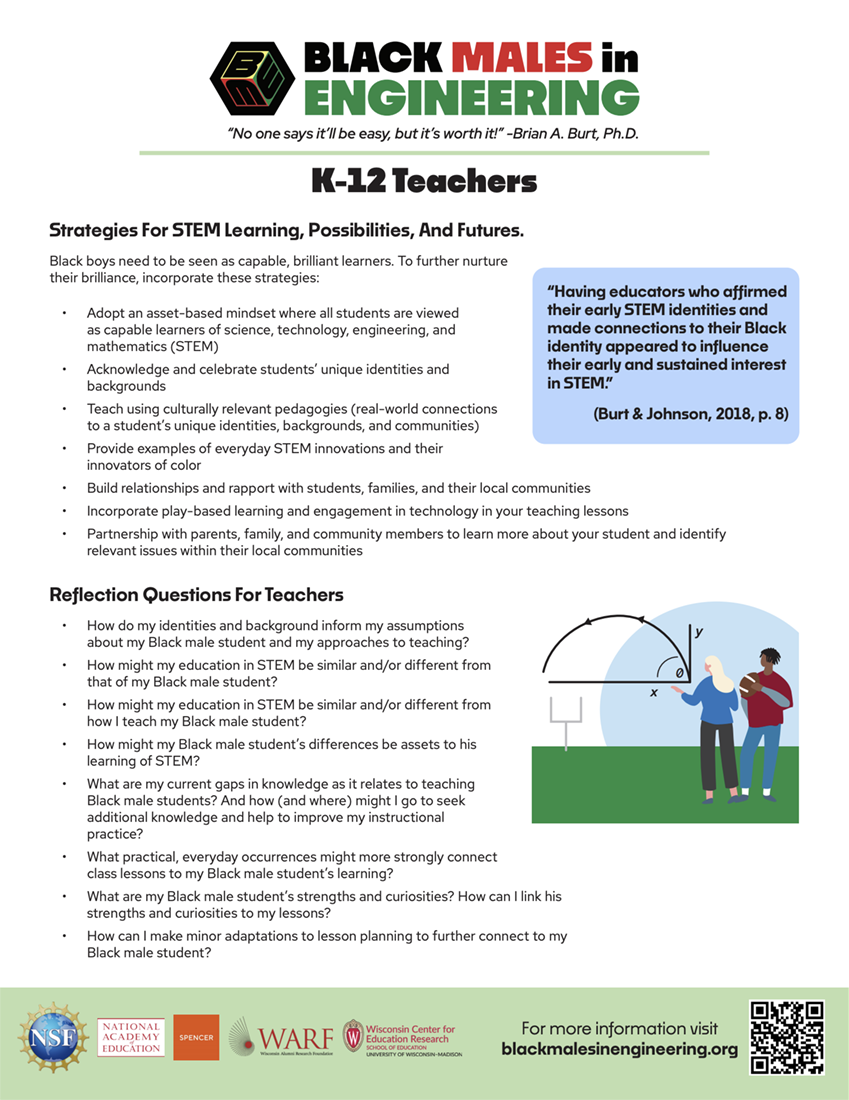
“Having educators who affirmed their early STEM identities and made connections to their Black identity appeared to influence their early and sustained interest in STEM.”
Associated Research Articles

Burt, B. A., Stone Jr., B. D., Porter, T., & Wallace, J. D. (2023). Aspiring to the road less traveled: Factors influencing Black males’ pursuits of engineering graduate degrees. Journal of Women and Minorities in Science and Engineering, 29(5), 65-92.
Burt, B. A., Roberson, J., Johnson, J., & Bonanno, A. (2020). Black men in engineering graduate programs: A theoretical model of the motivation to persist. Teachers College Record, 122(11), 1-58.
Burt, B. A., Williams, K. L., & Palmer, G. J. M. (2019). It takes a village: The role of emic and etic adaptive strengths on the persistence of Black men in engineering graduate programs. American Educational Research Journal, 56(1), 39-74.
Burt, B. A., & Johnson, J. (2018). Origins of STEM interest for Black male graduate students in engineering. School Science and Mathematics, 118(6), 257-270.
Join in the conversation via social media (#BlackMalesinEngineering) to share what you learn from this website, and share your own stories and techniques you have found that work toward Black male success in STEM.
This material is based upon work supported by the National Science Foundation under Award No. 2016440. Any opinions, findings, conclusions or recommendations expressed in this material are those of the author(s) and do not necessarily reflect the views of the National Science Foundation.