Success
Of Triumph and Perseverance: Black Male Success Through STEM Pathways
Tips For Students, Advisors And Mentors
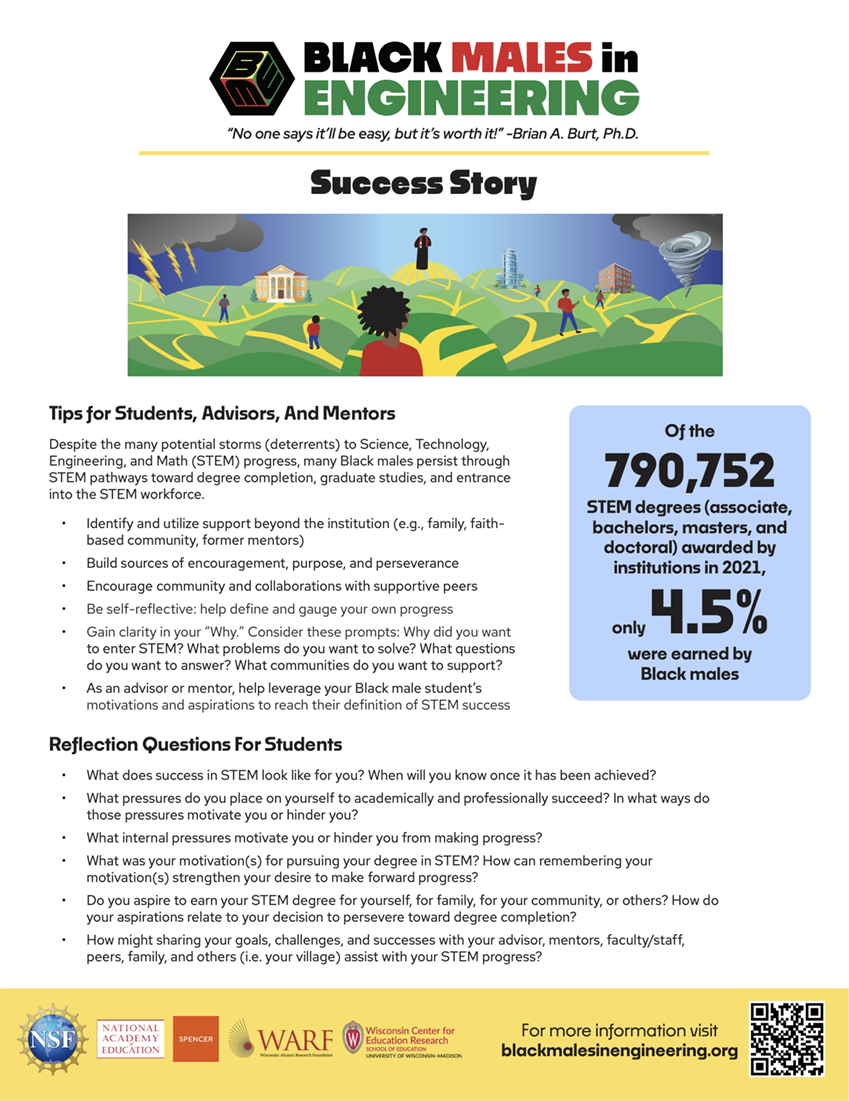
Despite the many potential storms (deterrents) to Science, Technology, Engineering and Mathematics (STEM) progress, many Black males persist through STEM pathways toward degree completion, graduate studies, and entrance into the STEM workforce.
- Identify and utilize support beyond the institution (e.g., family, faith-based community, former mentors)
- Engage sources of encouragement, purpose, and perseverance
- Build community and collaborations with supportive peers
- Be self-reflective: help define and gauge your own progress
- Gain clarity in your “Why.” Consider these prompts: Why did you want to enter STEM? What problems do you want to solve? What questions do you want to answer? What communities do you want to support?
- As an advisor or mentor, help leverage your Black male student’s motivations and aspirations to reach their definition of STEM success
Of the
790,752
STEM degrees (associate, bachelor’s, master’s, and doctoral) awarded by institutions in 2021,
only 4.5% were earned by Black males.
(National Center for Education Statistics, 2022)

Reflection Questions When Engaging Students
- What does success in STEM look like for you? When will you know once it has been achieved?
- What internal pressures do you place on yourself to academically and professionally succeed? In what ways do those pressures motivate you or hinder you?
- What external pressures motivate you or hinder you from making progress?
- What was your motivation(s) for pursuing your degree in STEM? How can remembering your motivation(s) strengthen your desire to make forward progress?
- Do you aspire to earn your STEM degree for yourself, for family, for your community, or others? How do your aspirations relate to your decision to persevere toward degree completion?
- How might sharing your goals, challenges, and successes with your advisor, mentors, faculty/staff, peers, family and others (i.e., your village) assist with your STEM progress?
Printable Handout
Each handout includes general information about Black males along various STEM pathways, tips or recommended practices, and reflection questions. The reflective questions have been provided to support ongoing conversations toward the support of Black males in STEM. The questions can be used individually or as a group.
Associated Research Articles

Burt, B. A., McCallum, C. M., Wallace, J. D., Roberson, J., Bonanno, A., & Boerman, E. (2021). Moving toward stronger advising practices: How Black males’ experiences at HPWIs advance a more caring and wholeness-promoting framework for graduate advising. Teachers College Record, 123(10), 31-58.
Burt, B. A., Roberson, J., Johnson, J., & Bonanno, A. (2020). Black men in engineering graduate programs: A theoretical model of the motivation to persist. Teachers College Record, 122(11), 1-58.
Burt, B. A. (2020). Demystifying the Monolithic Black Male Mystique: Advancing a Research Agenda on Black Men in Engineering Graduate Programs. SANKOFA: Exploring the Racial and Cultural Implications for Doctoral Education from the African American Perspective.
Burt, B. A., McKen, A., Burkhart, J., Hormell, J., & Knight, A. (2019). Black men in engineering graduate education: Experiencing racial microaggressions within the advisor-advisee relationship. Journal of Negro Education, 88(4), 493-508.
Burt, B. A., Williams, K. L., & Smith, W. A. (2018). Into the storm: Ecological and sociological impediments to Black males’ persistence in engineering graduate programs. American Educational Research Journal, 55(5), 965-1006.
Burt, B. A., Knight, A., & Roberson, J. (2017). Racializing experiences of foreign-born and ethnically diverse Black male engineering graduate students: Implications for student affairs practice, policy, and research. Journal of International Students, 7(4), 925-943.
View other Videos in the Series
Join in the conversation via social media (#BlackMalesinEngineering) to share what you learn from this website, and share your own stories and techniques you have found that work toward Black male success in STEM.
This material is based upon work supported by the National Science Foundation under Award No. 2016440. Any opinions, findings, conclusions or recommendations expressed in this material are those of the author(s) and do not necessarily reflect the views of the National Science Foundation.