College
Digging Deep: Navigating STEM Pathways in College
Common Deterrents To STEM Progress
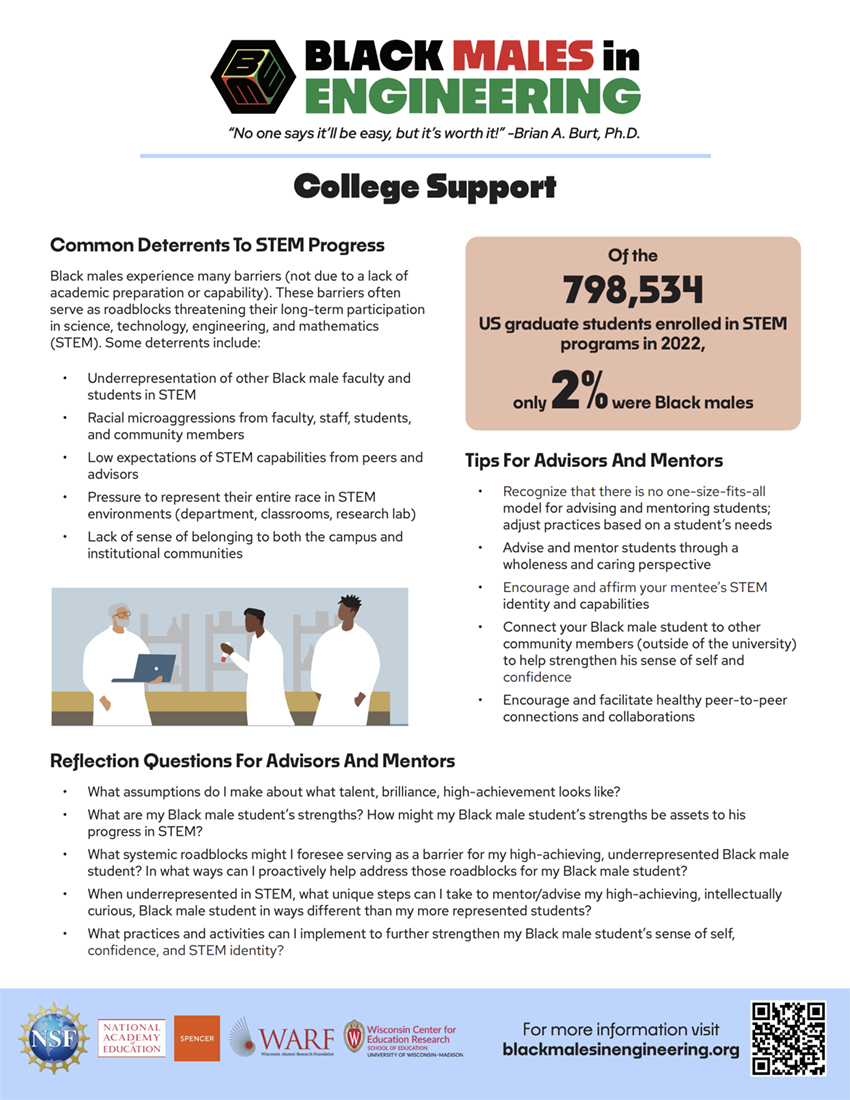
Black males experience many barriers, though not due to a lack of academic preparation or capability. These barriers often serve as roadblocks threatening their long-term participation in science, technology, engineering, and mathematics (STEM). Some deterrents include:
- Underrepresentation of other Black male faculty and students in STEM
- Racial microaggressions from faculty, staff, students, and community members
- Low expectations of STEM capabilities from peers and advisors
- Pressure to represent their entire race in STEM environments (department, classrooms, research lab)
- Lack of sense of belonging to both the campus and institutional communities

Tips for Advisors and Mentors
- Recognize that there is no one-size-fits-all model for advising and mentoring students; adjust practices based on a student’s needs
- Advise and mentor students through a wholeness and caring perspective
- Encourage and affirm your mentee’s STEM identity and capabilities
- Connect your Black male student to other community members (outside of the university) to help strengthen his sense of self and confidence
- Encourage and facilitate healthy peer-to-peer connections and collaborations
Of the
798,534
U.S. graduate students enrolled in STEM programs in 2022,
only 2% were Black males.
(National Science Foundation, 2022)
Reflection Questions For Advisors And Mentors
- What assumptions do I make about what talent, brilliance and high achievement look like?
- What are my Black male student’s strengths? How might my Black male student’s strengths be assets to his progress in STEM?
- What systemic roadblocks might I foresee serving as a barrier for my high-achieving, underrepresented Black male student? In what ways can I proactively help address those roadblocks for my Black male student?
- When underrepresented in STEM, what unique steps can I take to mentor/advise my high-achieving, intellectually curious, Black male student in ways different than my more represented students?
- What practices and activities can I implement to further strengthen my Black male student’s sense of self, confidence, and STEM identity?
Printable Handout
Each handout includes general information about Black males along various STEM pathways, tips or recommended practices, and reflection questions. The reflective questions have been provided to support ongoing conversations toward the support of Black males in STEM. The questions can be used individually or as a group.
Associated Research Articles

Burt, B. A., McCallum, C. M., Wallace, J. D., Roberson, J., Bonanno, A., & Boerman, E. (2021). Moving toward stronger advising practices: How Black males’ experiences at HPWIs advance a more caring and wholeness-promoting framework for graduate advising. Teachers College Record, 123(10), 31-58.
Burt, B. A. (2020). Demystifying the Monolithic Black Male Mystique: Advancing a Research Agenda on Black Men in Engineering Graduate Programs. SANKOFA: Exploring the Racial and Cultural Implications for Doctoral Education from the African American Perspective.
Burt, B. A., McKen, A., Burkhart, J., Hormell, J., & Knight, A. (2019). Black men in engineering graduate education: Experiencing racial microaggressions within the advisor-advisee relationship. Journal of Negro Education, 88(4), 493-508.
Burt, B. A., Williams, K. L., & Smith, W. A. (2018). Into the storm: Ecological and sociological impediments to Black males’ persistence in engineering graduate programs. American Educational Research Journal, 55(5), 965-1006.
View other Videos in the Series
Join in the conversation via social media (#BlackMalesinEngineering) to share what you learn from this website, and share your own stories and techniques you have found that work toward Black male success in STEM.
This material is based upon work supported by the National Science Foundation under Award No. 2016440. Any opinions, findings, conclusions or recommendations expressed in this material are those of the author(s) and do not necessarily reflect the views of the National Science Foundation.